Dear Little Friend: Impressions of Galka Scheyer
On View:
February 20, 2026 - July 20, 2026
Release Date:
December 10, 2025
Pasadena, CA — Opening at the Norton Simon Museum on February 20, 2026, Dear Little Friend: Impressions of Galka Scheyer offers an intimate view of the German-born art dealer and collector Galka Scheyer (1889–1945), known for her pivotal role in bringing European modernism to the United States and promoting the so-called Blue Four—Lyonel Feininger, Alexei Jawlensky, Paul Klee and Vassily Kandinsky. This focus exhibition looks at her legacy through a lesser-known aspect of her life—the friendships she forged with both artists and supporters.
Drawn from Scheyer’s archive and collection, which was transferred to the Pasadena Art Institute (now the Norton Simon Museum) in 1953, the exhibition features portraits of Scheyer given to her by artists Alexei Jawlensky, Maynard Dixon, Peter Krasnow and Beatrice Wood, among others. Alongside these are correspondence and ephemera that testify to her dedication to art and to her artists, as well as the excitement she generated in pursuing her mission. The exhibition title, Dear Little Friend, is taken from the affectionate salutation Feininger adopted in his letters to Scheyer and encapsulates the personal relationships and collaborative spirit that defined her enterprise in Europe and California.
Scheyer began her career as a painter in Braunschweig, Germany, but after meeting Jawlensky in 1916, she emerged as a dynamic advocate for modern art. Through Jawlensky, she was introduced to the vibrant arts communities of Europe, befriending Bauhaus masters Lyonel Feininger, Vassily Kandinsky and Paul Klee. She united these artists under the name “the Blue Four,” signaling their camaraderie and spiritual affinities, for the purpose of promoting their work in the United States beginning in 1924.
Settling in California in 1925, Scheyer became a pivotal force in introducing European modernism to American audiences. Her lectures, educational programs and exhibitions in the Bay Area and Los Angeles helped establish the region as a burgeoning center for modern art. Maynard Dixon, known for his iconic depictions of the American West, immediately endorsed her work. His playful inscription “To Madame Moderne Kunst” (To Ms. Modern Art), below his 1925 portrait of Scheyer, is a fitting tribute to the excitement she sparked within the San Francisco arts community.
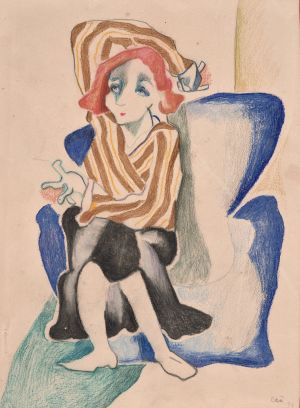
When Scheyer moved to Los Angeles full-time in 1933, she continued to expand her circle to include artists, collectors and cultural luminaries such as Beatrice Wood, Louise and Walter Arensberg and architect Richard Neutra, who designed her home-cum-gallery space in the Hollywood Hills. Dear Little Friend features Wood’s vivid colored pencil drawing, which captures the dynamic, performative energy of Scheyer’s presentations.
This exhibition offers a nuanced perspective on Scheyer’s professional life and on the deep relationships she fostered. A cultural force and a confidante to the budding California arts community, Scheyer was, in the words of photographer Edward Weston, “the ideal ‘go-between’ for the artist and his public.”
Dear Little Friend: Impressions of Galka Scheyer is organized by Gloria Williams Sander, Curator at the Norton Simon Museum. A series of public programs will be offered in conjunction with the exhibition, including the lecture “Close Circles: A Portrait of Galka Scheyer as the Artist’s Friend” by Williams Sander on Saturday, April 18 at 5:00 p.m. Details may be found at nortonsimon.org.
IMAGE CREDIT: Beatrice Wood (American, 1893–1998), Portrait of Galka Scheyer, 1934, Colored pencil on paper, 15 1/4 x 9 1/2 in. (38.7 x 24.1 cm), Norton Simon Museum, The Blue Four Galka Scheyer Collection, © Beatrice Wood Center for the Arts/Happy Valley Foundation
About the Norton Simon Museum
The Norton Simon Museum is known around the world as one of the most remarkable private art collections ever assembled. Over a 30-year period, industrialist Norton Simon (1907–1993) amassed an astonishing collection of European art from the Renaissance to the 20th century, and a stellar collection of South and Southeast Asian art spanning 2,000 years. Modern and Contemporary Art from Europe and the United States, acquired by the former Pasadena Art Museum, also occupies an important place in the Museum’s collections. The Museum houses more than 12,000 objects, roughly 800 of which are on view in the galleries and gardens.
Location: The Norton Simon Museum is located at 411 W. Colorado Blvd. at Orange Grove Boulevard in Pasadena, Calif., at the intersection of the Foothill (210) and Ventura (134) freeways. For general Museum information, please call (626) 449-6840 or visit nortonsimon.org. Hours: The Museum is open Thursday through Monday, 12 p.m. to 5 p.m. (Friday and Saturday to 7 p.m.). It is closed on Tuesday and Wednesday. Admission: General admission is $20 for adults and $15 for seniors. Members, students with I.D., and patrons age 18 and under are admitted free of charge. The first Friday of the month from 4 to 7 p.m. is free to all. The Museum is wheelchair accessible. Parking: Parking is free but limited, and no reservations are necessary. Public Transportation: Pasadena Transit stops directly in front of the Museum. Please visit http://pasadenatransit.net for schedules. The MTA bus line #180/181 stops in front of the Museum. The Memorial Park Station on the MTA A Line, the closest Metro Rail station to the Museum, is located at 125 E. Holly St. at Arroyo Parkway. Please visit www.metro.net for schedules. Planning your Visit: For up-to-date information on our guidelines and protocols, please visit nortonsimon.org/visit.  @nortonsimon
 @nortonsimon
 /nortonsimonmuseum
Press Contact
Jessica McCormack
(323) 497-9308
[email protected]
Leslie Denk
(626) 844-6900
[email protected]
Press Kit
Request Images
High-resolution images from the exhibition may be obtained by emailing [email protected]
Related Links
Read more about the exhibition.